Evidence-Based ABA Therapy Manila: A 30-Year Legacy From UCLA
When parents begin searching for autism treatment, they often come across the term ABA (Applied Behavior Analysis).
But many families may not know where ABA therapy began — or why the origins of a treatment approach still matter today.
The modern foundation of evidence-based ABA therapy can be traced back to the UCLA Young Autism Project, where researchers and clinicians explored an important question:
“What if children with autism were not limited by their diagnosis — but by how they were taught?”
That question helped shape the future of autism intervention worldwide and continues to influence high-quality ABA therapy or intensive one-on-one APM therapy in Manila and around the world today.
The Landmark UCLA Autism Study
In 1987, Dr. O. Ivar Lovaas published a landmark study through UCLA that transformed the field of autism treatment.
The study demonstrated that children with Autism Spectrum Disorder (ASD) could make significant developmental progress through early, intensive behavioural intervention.
At a time when many believed children with autism had limited learning potential, the findings challenged long-standing assumptions and introduced a new perspective:
Children with autism could learn, grow, and develop meaningful skills when provided with effective teaching and individualized intervention.
The study became one of the foundational pieces of research behind modern evidence-based ABA therapy used throughout the world today.
More importantly, it established a belief that continues to guide quality autism treatment:
Every child has the capacity to learn.
From UCLA to Autism Partnership
Among the clinicians trained at the UCLA Young Autism Project were Dr. Ronald Leaf and Dr. John McEachin, Co-founder and Director of Autism Partnership.
Working directly within the UCLA program, they were involved in autism intervention, curriculum development, staff training, behavioural strategies, and research that would later influence autism services internationally.
Through years of clinical work, they recognized something important:
Progress was not simply about teaching isolated skills.
Children learned best when they were motivated, engaged, attentive, flexible, and emotionally connected to the learning process.
They observed that when children developed “learning how to learn” skills, progress became more meaningful, more natural, and more sustainable.
In 1994, Dr. Ronald Leaf and Dr. John McEachin founded Autism Partnership with the goal of refining and advancing autism intervention beyond rigid teaching models.
Rather than creating a one-size-fits-all program, Autism Partnership focused on developing a more individualized, responsive, and clinically driven approach to ABA therapy.
From the beginning, Autism Partnership emphasized:
Individualized teaching strategies
Careful clinical judgment
Natural motivation during therapy
Flexibility within sessions
Ongoing program adjustments based on each child’s progress
The goal was never simply to complete programs or teach rehearsed responses, but to help children build meaningful skills that could generalize into everyday life.
The Autism Partnership Method® (APM®)
Over more than 30 years, the Autism Partnership Method® (APM®) has continued to evolve through direct clinical work, supervision, long-term outcome observation, and ongoing research.
Rather than remaining fixed, the approach has been continuously refined through the experiences of real children and real families around the world.
Today, APM® is recognized as a progressive model of ABA therapy that combines evidence-based behavioural principles with active clinical analysis and individualized teaching strategies.
The approach places strong emphasis on helping children remain:
Motivated
Engaged
Flexible
Socially connected
Able to apply skills across real-life situations
The goal is not only successful therapy sessions, but meaningful progress that extends into home life, school environments, community settings, and everyday interactions.
This philosophy continues to shape every therapy session provided at Autism Partnership Manila.
Why Clinical Lineage Matters in ABA Therapy
Not all ABA therapy programs are developed from the same clinical background.
When families choose an autism treatment provider, they are not only choosing a therapy service. They are also choosing the clinical philosophy, training background, leadership experience, and effective treatment approach guiding their child’s development.
Autism Partnership’s clinical roots trace directly back to the UCLA Young Autism Project — one of the most influential foundations of autism intervention ever published.
That lineage continues today through ongoing:
Clinical supervision
Staff training
Research
Program refinement
Long-term treatment experience with children with ASD
For families seeking evidence-based ABA therapy in Manila, understanding a provider’s clinical foundation can play an important role in choosing quality autism treatment.
A Global Organization Guided by One Philosophy
Since its founding in 1994, Autism Partnership has expanded internationally while maintaining the same clinical philosophy that shaped its beginnings.
Across all offices, more than 400 professionals receive ongoing training informed by active clinical work, research, and long-term autism treatment experience.
Although cultures, languages, and communities may differ, the goal remains the same:
To provide individualized, high-quality autism intervention that helps children build meaningful and lasting skills.
ABA Therapy Manila at Autism Partnership Philippines
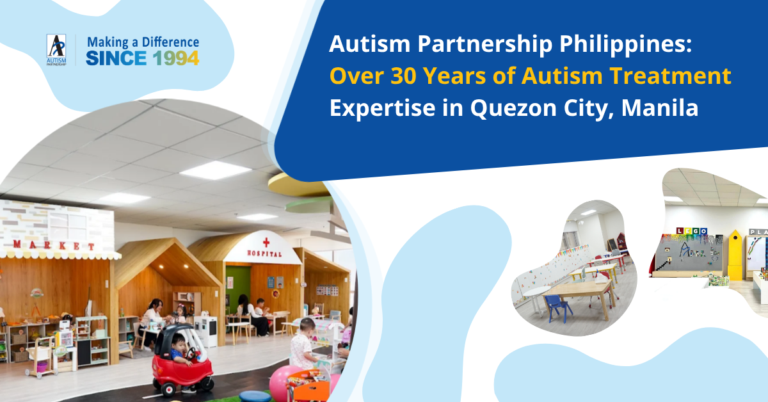
Today, Autism Partnership Philippines continues this 30-year clinical legacy by providing Progressive ABA therapy for children with autism in Quezon City, Manila.
As part of the Autism Partnership Asia network, AP Manila combines international expertise with individualized treatment programs designed to help children develop communication, social, behavioural, learning, and independence skills.
Families seeking ABA therapy in Manila can benefit from a treatment approach shaped by decades of clinical refinement, evidence-based practices, and hands-on autism intervention experience.
Learn More About Autism Partnership Manila
With over 30 years of clinical refinement, research, and hands-on autism treatment experience, Autism Partnership continues to help children with ASD build meaningful communication, learning, social, and life skills through individualized Progressive ABA therapy.
ABA (Applied Behavior Analysis) is an evidence-based approach to autism treatment that focuses on helping children develop communication, social, behavioural, and learning skills.
The Autism Partnership Method® (APM®) is a progressive form of ABA therapy developed through over 30 years of clinical experience, research, and individualized autism intervention.
Clinical lineage reflects the training background, philosophy, supervision standards, and experience behind a therapy provider’s approach to autism intervention.
Since 1994, Autism Partnership has been dedicated to helping children with Autism Spectrum Disorder (ASD) reach their fullest potential through high-quality, individualized autism treatment. Founded by clinicians trained under the groundbreaking UCLA Young Autism Project, Autism Partnership was built on decades of clinical experience, research, and a deep belief that children with autism can make […]
In the DSM-V, the diagnostic criteria for Autism Spectrum Disorder (ASD) describes four behavior symptoms. One of those symptoms is “Stereotyped or repetitive motor movements, use of objects, or speech (e.g., simple motor stereotypies, lining up toys or flipping objects, echolalia, idiosyncratic phrases).” Even though demonstrating these repetitive behaviors is not a requirement for diagnosis, […]
It’s natural for parents to compare their child to others, including among those raising a child with ASD. Many parents ask why their child isn’t making the same progress as other children, despite following the same intervention program. While we fully understand these concerns, we strongly recommend that parents avoid comparisons. Each child with autism […]