Help Your Child Thrive in an Uncertain World

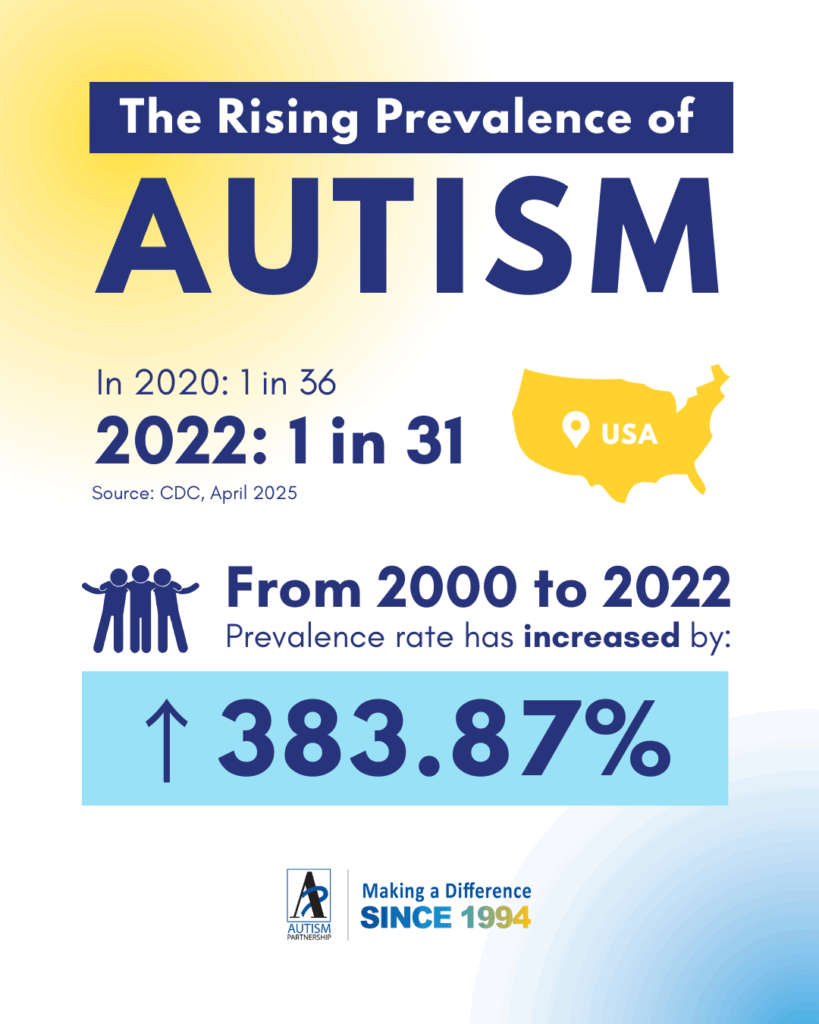
Autism rates are increasing, and while the cause is still unknown, early understanding and support can make all the difference.

What are the Signs and Symptoms of ASD?

With the advancement in diagnostic tools, most children with autism can be reliably diagnosed by the age of 3, and earlier diagnosis is possible even for children as young as 12 months old.

Although symptoms of autism vary from child to child, the core areas affected include:

Prognosis of Autism Spectrum Disorder

There are many factors that contribute to the long-term treatment outcome of a child with autism. Some of these factors can be controlled and some cannot.

Research has shown that children starting at the same age, with the same intensity, consistency of treatment, and same treatment choice, may have different treatment outcomes. This, we believe, is due to the individual cognitive ability of the child. Some children may learn vary fast and others may learn slower. Some children may find it difficult to learn abstract concepts, while others may become fluent in all areas.

It has been well documented that children with ASD benefit the most in the early years. Early intervention is critical to ensure the maximum progress. This is not to say that older children do not benefit from treatment–they definitely can benefit from behavior intervention. However, as children get older, the developmental gaps become wider and it becomes more difficult to catch up. Thus, it is essential to begin intervention as early as possible.

It is critical to ensure that the treatment your child receives is of a high quality. There is tremendous variability in the quality of treatment services. Providers may claim to provide treatment services without the proper training or quality control. Professional and well-qualified treatment Therapists should receive ongoing extensive training and supervision by experts in the field. Your program should be as good as the person who designs the curriculum and the people that implement it.

Children with autism face the formidable challenge of not only trying to catch up the developmental gaps that already exist but also they need to keep up their learning pace with their peers to ensure that the gaps do not widen. For example, a child who has a 2-year delay in language may only learn one year of language in a year. This would normally be ideal as it represents a lot of progress. However, the two-year delay still exists because the child is older and his peers have acquired another year of knowledge. In order to actually catch up, the student needs to learn more than one year of language in a year. If the student caught up 1.5 years of language every year, it would then take him or her 4 years to finally catch up with peers. This then presents a real challenge. Given the multitude of deficits that are often present with autism, it is critical that all areas are taught intensively and systematically. It is not unlike taking a child and training him or her to become an Olympic swimmer. Spending one hour a week on one of the deficit areas that is 2 years behind is unlikely to yield the results we may wish for. Research has consistently shown that a high volume of hours is ideal to maximize a child’s learning progress.

In order to maximize program progress, it is critical that the whole treatment team provides service in a consistent approach. If the student is doing sign language in the morning and using pictures to communicate in the afternoon, it is likely to result in confusion on the part of the student. If a number of practitioners are working together, it is then essential that they meet regularly to formulate a comprehensive plan so that the treatment can be consistent. This is also true for the consistency between parents and the treatment team. Parents need to be involved and develop knowledge and expertise in treatment so as to help their child learn and generalize skills.

prevalence-of-autism-1

The rise in Autism Prevalence means:

Start early intervention when it matters most...

At Autism Partnership (AP), we adopt our very own treatment method called, Autism Partnership Method (APM™).

Play Video

AP Method™ is a progressive, high-quality and unique approach to autism treatment for individuals with ASD.

It is based on nearly 30 years of research and effective clinical practice. As a unique approach to autism treatment, the AP Method™ (APM) focuses on “in-the-moment analysis” and strong clinical judgment. It is highly flexible, yet systematic and compassionate—designed to meet the individual needs of people with ASD.

AP Method™ is not a cookie-cutter approach. It does not follow a fixed recipe. It recognizes that each child—and therefore the treatment—can change from moment to moment.

AP Method™ delivers intervention across multiple settings to ensure that progress carries over to real life, including the home, school, playground, store, workplace, and the wider community.

The APM™ focuses on:

A method supported by promising treatment results

photo-what-is-progressive-aba-and-how-does-it-differ-from-conventional-aba-autism-partnership-philippines_3

Key Elements to Achieve the Best Outcomes by Children with ASD

There are several studies demonstrating the effectiveness of the AP Method™ (APM) as a unique approach to autism treatment for individuals diagnosed with ASD, including a study conducted by Autism Partnership (2011). In these studies, the children with the best possible outcomes had these key elements in common:

Leap of Faith - Stories of Parents

I saw significant improvement on my son's behavior. He's more open to learning things on his own, his curiosity was piqued, and he started asking a lot of questions and he is now able to sit down and work on his academics. It definitely opened him to more opportunities that I didn't know was possible before.

Kimi’s Training Progress

“At first glance, Kimi seems like an ordinary child with an adorable smile and an energetic temperament. But at the age of 2, he was diagnosed with ASD and was non-verbal...”

AP Method FAQ

The Autism Partnership Method (APM) is a progressive and naturalistic approach to ABA therapy. It goes beyond traditional ABA methods by prioritizing individualized treatment, flexible teaching strategies, and a focus on developing meaningful social and communication skills.

With APM-based ABA therapy, we address a broad range of skills, including:

  • Communication skills: Verbal and non-verbal communication development.
  • Social skills: Playing, sharing, and interacting with peers.
  • Academic skills: Early learning concepts and problem-solving.
  • Self-help skills: Dressing, eating, and personal hygiene.
  • Behavior management: Reducing challenging behaviors and promoting positive alternatives.

Contact Us Today!

with concerns or for resources to help if your child has ASD and steps to take after receiving a diagnosis.

Thank You!

The form was submitted successfully

Thank you for contacting us

All information received will always remain confidential. We will contact you as soon as we review your message. Thanks

Thank You!

The form was submitted successfully

This site is registered on wpml.org as a development site.